
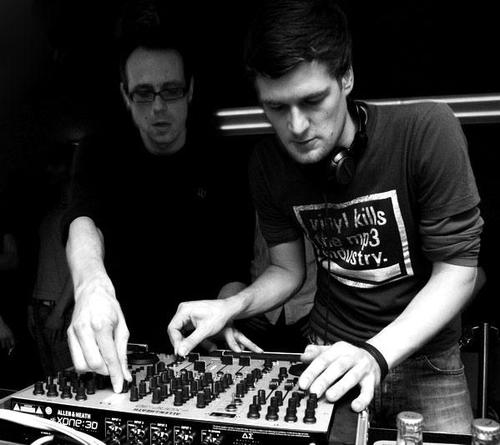
Kollektiv Turmstrasse

Christian Hilscher and Nico Plagemann are the musicians behind the duo Kollektiv Turmstrasse whose sound is pretty much a kind of minimal-techno/electro with strong melodic influences. Their big international breakthrough came in 2009 with the Kollektiv Turmstrasse Let Freedom Ring Rmx for Federleicht’s “On the Streets”. Before they had already gained strong credibility amongst Germany’s electronic music scene with tracks like Tristesse” (2007) and “Grillen im Park” (2007). In November 2010 the duo released their debut album “Rebellion der Träumer” (Rebellion Of The Dreamers).
BBM Magazine wanted to know more about what influences their music, live DJing versus their album and what the 100-loop-rule means for perfectionists.
Let’s look at the stations of your lives: You both grew up in very small cities (or villages) at the Baltic Sea in Germany, Nico from Bad Kleinen (~ 3,500 inhabitants) and Christian from Boltenhagen (~ 2,500 inhabitants). Then you moved to Wismar (~44,500 inhabitants) where you met in a club, finally shared a house and started to make music together. Later both of you moved to Hamburg (~1,8m inhabitants). How do you feel this journey in your lives has changed you?
Both: We both have amazing memories of our childhood days up in the countryside but we love where we are now. It’s like growing up and bigger, it a natural process. Without these different stages in our lives, our music wouldn’t be what it is today. We are very excited to see where else our journey will go. What’s our next destination; another city, another country? Changes in live mean further development; and this is important for us in music as well as personally.
Everybody goes to Berlin, Berlin seems to be Germany’s hub for electronic music. Why are you in Hamburg and not in Berlin? How would you explain the differences of the electronic music scene in Hamburg and in Berlin to our readers?
Both: We moved to Hamburg due to our previous jobs and studies. Soon we realised that Hamburg is actually a wonderful city. There is a great music scene, even if this is not that obvious as in Berlin. Since beginning of the 90s Hamburg has been a nucleus of electronic music in Germany. Back then we were not part of it yet but this spirit passes on and we feel it even today. Hamburg’s music scene is very vibrant with known labels and artists such as Dial with Pantha du Prince and Lawrence, Liebe & Detail with Mathias Meyer, Diynamic with Solomun and Stimming – and there are many more. Also our own small label “Musik Gewinnt Freunde” ties on to that. Hamburg has always been one of the creative hubs in Germany in the same way as Berlin or Frankfurt.
But the biggest difference probably is the size of the city and that most people are leaving the club on a Sunday to go home as they have to work on Monday. We heard that’s supposed to be different in Berlin…
“Kollektiv Turmstrasse” in English means “Collective Towerstreet”. Where does this name come from?
Both: Turmstrasse is a street where we first lived together in Wismar back in 1998. We had to find a name to use for a party flyer at a time when the collective as such actually didn’t exist yet. If we would have known that this name will stick with us, we would have put a few more thoughts into it. But it’s the name of the street where everything started – our music as well as our friendship.
Nico, you studied Music and Christian, you worked in IT for a very long time. Is it just a matter of course that you ended up producing electronic music or where does your passion for this type of music come from? How did you start DJing and what do you actually enjoy about it?
Christian: Both of us completed pretty ordinary apprenticeships first. At that time we already were very much into music, we bought records, went to parties and started our first experiments with music. It’s hard to say what triggered this passion or interest. The decision to actually study music was made one year later when we were sure: yes, music, that’s it. In the North East of Germany where we grew up, there were always wonderful open air beach parties with DJs and live acts who inspired us.
Nico: We were lucky then to release our music on albums and then things just kept on going…more releases, more remixes etc. And now we
will be coming to Australia to present our music, that’s great! Of course we also grew personality wise. Many things change as our hobby becomes your profession – people have to be able to rely on you, you have to commit to timelines and appointments and all such things. But we are very happy that we can do that and all our passion goes into our profession and love of making music.
In one of your interviews you said that Nico is a big fan of Snap. What’s your favourite music and how would you say it influences you in what you are doing today?
Christian: We are fans of different things such as IDM, old dub techno, northern listening. But our influences are wider than that. If it’s good food, a nice trip to the countryside or just a dinner with our friends – everything counts.
Nico: It just has to be catchy. And that was Snap when I was 14 years old and I will not forget it. But with 18 it was Radiohead and Al Green when I was 22 years old. Everybody knows these music moments in your life which you will never forget. But thank god we were always very open to music and it was never important how cool or underground something is. It just needs to wow us and then it automatically influences our own music.
In 2003 you started your netlabel “no response” and later in 2006 your vinyl label “Musik Gewinnt Freunde” (“Music wins Friends”). How important do you think the netlabel was for you and your musical career? How significant do you think are the internet and such netlabels today for new musicians considering that everybody can put up their work online and it sometimes feels like the internet is flooded with tracks of new musicians?
Both: “No response” was our first try, the only thing you needed was an internet connection. We produced music for quite a long time but there was no exchange or feedback from other musicians. This changed when the netlabel scene came up and we created our platform using the internet. We are grateful for this very exciting time during which we learned a lot. We are sure we wouldn’t be where we are today without the netlabel scene and “no response”.
These days everything is even crazier if you want to start a career and put music on the market. But in the end it’s always the quality that counts.
What is happening with your imprint “Musik Gewinnt Freunde” at the moment and what are your future plans with it?
Both: “Musik Gewinnt Freunde” for us is not a label as such; it’s more a ‘playground’ for us and our friends. Due to working on our debut album we slightly to cut down our activities with “Musik Gewinnt Freunde” but now we started again. There are lots of different things in the pipeline. We are working with new artists, artists who already have been with us, we are working on our new EP – so watch out.
Tell us a bit more about your debut album “Rebellion der Träumer” (“Rebellion of Dreamers”).
Your album appears quite different from your DJ sets. Your album seems more chillout, full of reverie, melancholy and a bit of fragility. On the other hand your live sets push forward and are loaded with positive energy and playfulness. What made you choose this approach of working in different directions?
Nico: With the album “Rebellion der Träumer” we wanted to create our own, let it out and do what we wanted to do. It is a kind of soft anarchy for us. We already knew at the beginning that most people might expect something that is more dancefloor-focused – but that’s exactly what we wanted to break with. Kollektiv Turmstrasse is more than that and we wanted to show it. People should listen to a different side of Kollektiv Turmstrasse. An album as format is the ideal platform to do this. With an EP you will never be able to tell the whole story and with “Rebellion der Träumer” we could do that without compromising.
But of course we won’t forget that we are also performing live in clubs where it’s about fun and partying. Therefore we edited the album one more time so it can be played in clubs too without having to worry that people just might be stuck at the bar. Seriously, in this regard we have to match expectations and this mostly means “we want to dance”.
I actually had to think about drawings of Caspar David Friedrich* and Carl Gustav Carus* the first time I was listening to your album. Well, this might also be because I know you are kind of “Northern lights”. If you could associate a painter or writer with your album or a certain track, who would this be?
Nico: Thanks for this question, and yes we think with our album we tried to create a piece of art as such. For me there were quite often associations with certain artists such as painters. But that’s the good thing with art in general: art triggers different senses but can result in the same feelings – and it can preserve these. For some time I tried to approach music from a romantic or expressionistic angle and also was interested in the history of arts. If I would have to, I would see our album as surrealism where verything is a bit dreamful and the borders between reality and fantasy are diffuse. I think that happens a lot with our music.
In an article of German Raveline I read that you are visualizing music to then transform these pictures into sounds. What pictures did you have in mind for th
e song “Schwindelig” (“Dizzy”), which personally is my favourite track on your album? And where did you get the voice sample at the end of the song from?
Christian: There is no specific artist in our minds. Memories and reality are what influences our work. The beauty of nature, seen with your eyes and captured in your mind… You could almost say it’s the connection to the Nordic nature we set to music with our warm and organic sounds.
Nico: It is very important for us to have pictures associated with music or parts of music. That’s also what I mean by talking about preserving. You try to preserve moods and emotions with music. “Schwindelig” is a very good example for this: everything started with the feeling of being in love, the feeling when you are on cloud nine and the world starts spinning. I think I don’t have to say much more, you know what I am talking about…
Talking about the voice samples you are using. There are quite a few tracks or your album using vocals or voice samples. Where do you get them from and how do you make your choices?
Both: Florian Schirmacher, one of our good friends, sang the vocals for two tracks on this album. We also worked with Inga Goldin, who is a very talented female singer. But there is a lot we do ourselves. As mentioned earlier, we are not aiming to perfectly reflect reality. Therefore it sometimes can sound a bit fuzzy and blurred.
Looking at the history of your own labels, why did you finally release your debut album on Connaisseur Recordings?
Both: Releasing the album “Rebellion der Träumer” was a very important step for us and we put a lot of work into it. We needed the right partner, a label with structures and connections to promotions and sales. We couldn’t have done this with our own small label.
How long did it take you to produce the album and how did you start? What were your first ideas and what did you wanted to achieve with this album?
Both: We worked on this album for about 2 years and finished it step by step. At the beginning the direction wasn’t a 100% clear. But once we knew it, everything else happened very quickly.
You often say you are your biggest castigators, perfectionists, not easy in making decisions and it’s hard for you to consider a work as finished. How does this translate into your work and how do you experience working as a duo with this attitude?
Christian: On some tracks we have been working for aaaages 😉 Sometimes this really messes us up and we get a kind of stuck in a one-way road but in the end we always find a way out again.
That’s the good thing about being a duo – having two different opinions saves you from getting totally lost.
Could you describe how you work when you are in the studio? Tell us how such a typical studio day with the smallest collective of the world would be. And could you also explain your 100-loops-rule I read about.
Christian: Meeting in the studio at noon, starting the computers, making coffee and then working. At 2am shutting down the computers, switching off the coffee machine and the lights, lock the studio.J
Our 100-loops rule is pretty easy. If a part or a loop in an musical arrangement still doesn’t annoy you after listening to it 100 times it deserves his place in a track. We are perfectionists. There are many tracks which we started, put them to the side and find them again after months. We have another listen and see if we like them or if they still haven’t passed the 100-loop test. We are aiming to make timeless music and produce tracks that don’t have an expiry date.
I think you started to get international recognition when your first tracks were released on Cocoon compilations, right?! Now you are traveling all over the world, playing in the hottest clubs and at the hippest events: Fusion, Mayday, Amnesia/Ibiza, Moscow, Reykjavik, Tokyo – just to name a few. How did this influence your life as musicians as well as a private person?
Both: We try to enjoy our private life and the little time we got as much as possible. It’s rare that we see our families and friends but if so we make the best out of it. All these influences help a lot in the process of making music. But sometimes we would love to have more time for all those little things which make life as wonderful as it can be.
In Sydney you were playing at the “Tone” which is a smaller sized electronic music club. On the other hand you played at events such as Mayday, Nature One for thousands of people. What do you like more – playing at the big events or in small clubs?
Nico: Small clubs often are the secret for motivation. When you play in a small club and everybody is in the same mood to party then there is so much energy – that’s wonderful! So it’s not always about the size of a club. Bigger clubs often lack in personal atmosphere but on the other hand it’s louder and so on.
If you could choose your dream location to play, where would this be and how would your set be?
It would be at a beach during sunset or sunrise with lots of friends. What the set would be like? Let’s see then 😉
Interviewed by Kerstin Keimling
*Caspar David Friedrich (1774 – 1840) and Carl Gustav Carus (1789 – 1869) are German Romantic landscape painters who chose the costal landscape at the Baltic Sea to be one of their main motifs.
** In this voice sample a guy is telling about how he got sighted a few weeks ago walking through his hood. He was naked, just wearing his underpants, high heels and a blond wig. He had a girl in his right and one in his left arm. He ends his little anecdote with the sentence ‘Everything that makes me dizzy is awesome.’
More like thisRelated
Disability Friendly Accommodation in Sydney

How Seniors Can Stay Safe During Holiday Celebrations
Uluru Tours Northern Territory
How to Make Extra Money While Backpacking in Australia
Temp Jobs In Australia people2people

Drop Bear Adventures | Fraser Island Camping Tours
The Biggest Music Festivals in Australia 2025–2026

